Analysis
Play On or Stop? The Crossbar Controversy Splitting the NPFL
A critical analysis of the club statement of 5 November 2026 and the Matchday 9 fixture at the Awka City Stadium
November 5, 2026
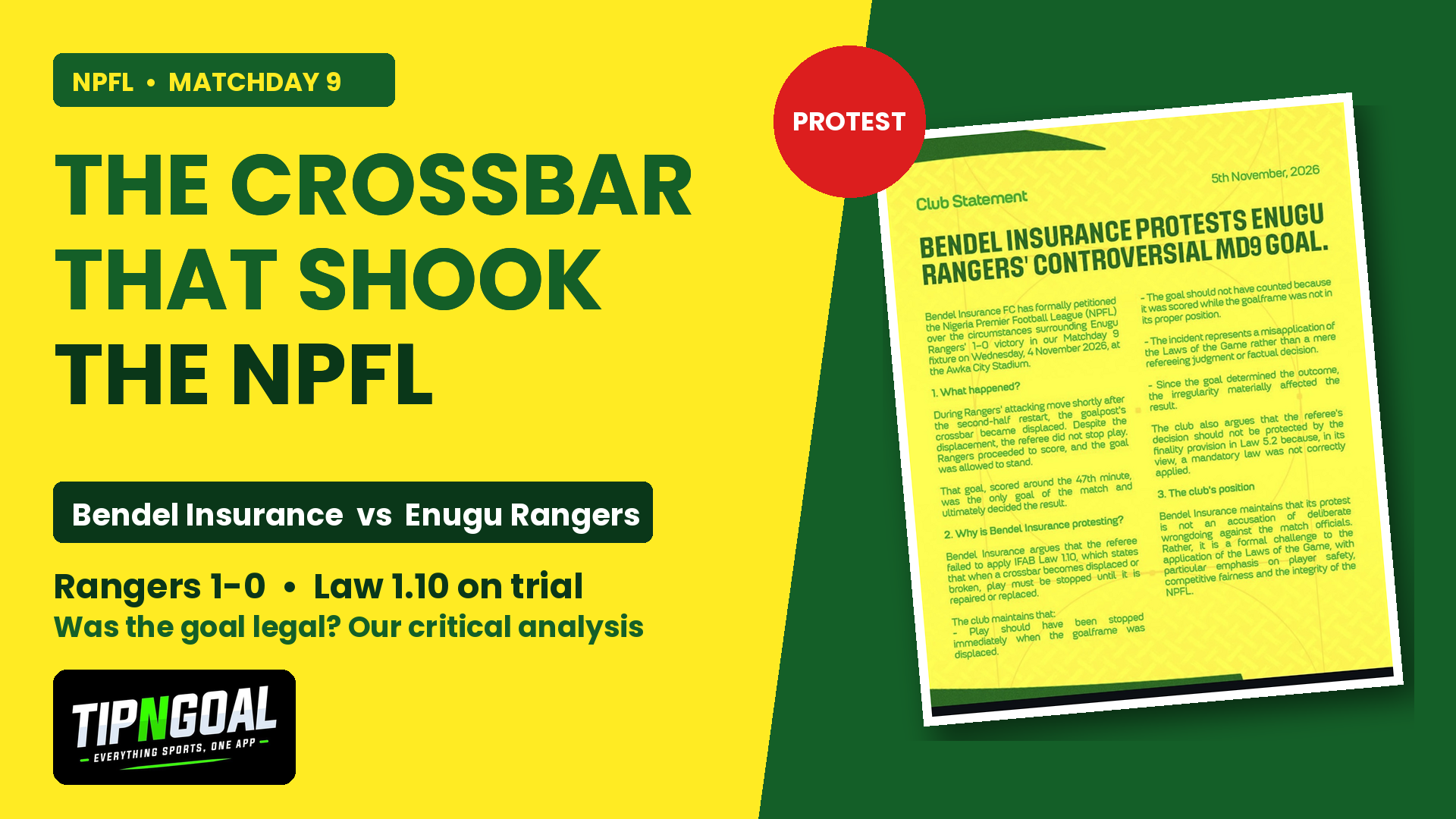
12d agoOn Wednesday, 4 November 2026, Enugu Rangers beat Bendel Insurance 1-0 in a rescheduled Matchday 9 fixture of the Nigeria Premier Football League (NPFL) at the Awka City Stadium. The only goal came two minutes into the second half, scored by Chidozie Iwundu, and it lifted Rangers to the top of the table on 21 points. Within a day, Bendel Insurance had published a formal club statement announcing a petition to the league. Their argument is simple to state and hard to settle: the crossbar was displaced before the goal was scored, IFAB Law 1.10 says play must be stopped when that happens, the referee did not stop play, and therefore the result should not stand.
This article takes that argument seriously, and then tests it. It is easy to write a heated piece in support of either club. It is harder, and more useful, to ask what the Laws of the Game actually say, what a league tribunal can realistically do with them, what evidence Bendel will need, and where their case is vulnerable. The conclusion, in advance: Bendel have chosen a smart legal framing and a respectable principle, but the outcome of the protest will turn on facts the public statement does not yet establish, and on how willing the NPFL is to treat a refereeing error as an error of law rather than an error of judgment.
A note on sources. The account of what happened comes from two places: Bendel’s own statement, which is an interested party’s version, and early match reports. One match report describes the goal as a header from a long throw-in in the 47th minute, following an earlier delivery that Bendel’s goalkeeper had dealt with, and says the crossbar was reportedly dislodged in that sequence. Nothing I have found yet carries the response of Rangers, the referee, the match commissioner or the NPFL. Everything below should be read with that in mind.
1. What Bendel Insurance are actually claiming
It helps to separate the statement into its parts, because the parts are not equally strong.
The factual claims.
Bendel say that during a Rangers attacking move shortly after the restart, the crossbar became displaced; that the referee did not stop play; that Rangers scored; and that the goal, around the 47th minute, was the only goal of the match.
The legal claims.
Bendel say the referee failed to apply Law 1.10, which they summarise as requiring play to be stopped until a displaced or broken crossbar is repaired or replaced. They say the goal should not have counted because it was scored while the goalframe was not in its proper position. They say this is a misapplication of the Laws rather than a refereeing judgment or a decision of fact. They say the goal determined the outcome. And they argue that the referee’s decision should not enjoy the finality protection of Law 5.2, because a mandatory law was not correctly applied.
The positioning claims.
Bendel stress that this is not an accusation of deliberate wrongdoing against the officials, but a formal challenge about the application of the Laws, with emphasis on player safety, competitive fairness and the integrity of the NPFL.
Each layer matters. The factual claims have to be proved. The legal claims have to be accepted. The positioning claims are there to make acceptance easier. A tribunal that is sympathetic to the third layer can still reject the first two.
2. What the Laws say, and what they do not say
Law 1: the field of play and the goals
Law 1 of the IFAB Laws of the Game deals with the field of play. Its section on goals sets out how the goals must be built and positioned, and it includes a specific instruction for the situation Bendel describe: if the crossbar becomes displaced or broken, play is stopped until it has been repaired or replaced in position; if repair is not possible, the match is abandoned; and the use of a rope in place of a crossbar is not permitted. Bendel’s summary of the provision matches that general effect. Anyone publishing material about this dispute should check the wording against the current edition of the Laws, because IFAB revises the text every year and the numbering of sub-sections has shifted over the years.
Two features of this provision deserve attention.
First, it is written in mandatory language. It is not a discretionary power (“the referee may stop play”). It is a direction (“play is stopped”). That supports Bendel’s claim that there was no judgment call to be made: once the crossbar is displaced, the law is engaged.
Second, it says nothing about the consequences for a goal scored while the crossbar is displaced. It tells the referee what to do, not what the competition should do afterwards. That gap is the soft underbelly of Bendel’s case, and we will return to it.
Law 5: the referee, and the finality of decisions
Law 5.2 deals with the decisions of the referee. In summary, decisions must be made to the best of the referee’s ability according to the Laws and the spirit of the game, are based on the referee’s opinion, and the referee has discretion to act within the framework of the Laws. Crucially, the decisions of the referee on facts connected with play, including whether or not a goal is scored and the result of the match, are final.
That final sentence is the wall Bendel have to climb. Football’s governing structures have spent more than a century building the principle that you cannot re-litigate what happened on the pitch. A league that allowed results to be reopened every time a team disliked a call would not have a league for long.
Bendel’s answer to the wall is to argue that Law 5.2 protects decisions “regarding facts connected with play”, and that what happened here was not a decision about a fact but the omission of a mandatory step. It is an argument that has a respectable shape. But it has to survive the next question: was the referee’s failure to stop play a failure to apply the law, or a failure to notice a fact?
Law 10: how a goal is scored
Law 10 provides that a goal is scored when the whole of the ball passes over the goal line, between the goalposts and under the crossbar, provided no offence has been committed by the team scoring. Notice that the law is built around the geometry of an intact goal. With a displaced crossbar, the phrase “under the crossbar” becomes physically uncertain. If the bar is hanging at one end, resting on the net, or lying on the ground, where exactly is the upper boundary of the goal? That is an argument Bendel could make, and the public statement only gestures at it when it says the goal was scored while the goalframe was not in its proper position. If the ball plainly entered at a height that would have been under an intact crossbar, the argument loses force. If the position of the bar made the entry point genuinely uncertain, the argument gains force.
3. The central question: error of law or error of fact?
Almost every sports tribunal in the world draws a line between two kinds of mistake.
An error of fact or judgment is where the referee sees something and decides it wrongly, or does not see something. Was it a foul? Was it offside? Did the ball cross the line? These are the decisions that the field-of-play principle protects, even when replays prove the referee wrong.
An error of law is where the referee knows the facts but applies the wrong rule, or ignores a rule that has to be applied. Awarding a goal kick when the ball went out off the defender and the referee believes it should be a corner is a fact error. Awarding a free kick for a foul outside the penalty area as if it were a penalty, while knowing the foul was outside, would be closer to an error of law. In practice, the line is blurry, and tribunals tend to push cases toward the “fact” side because that keeps results stable.
How Bendel’s case fits
Bendel want to put this incident in the law category. Their best reasoning runs like this: the displacement of the crossbar was visible, it was not subtle, it triggered a mandatory stoppage, and the referee’s failure to stop play was a failure to apply the Law.
The obvious reply, which Rangers and the league are likely to make, runs like this: the referee’s duty to stop play depends on the referee being aware that the crossbar was displaced; whether he was aware, and whether the displacement was significant enough to count, are matters of fact and opinion; and the goal was a decision on whether a goal was scored, which Law 5.2 puts beyond challenge.
Which characterisation prevails depends on evidence about three specific questions.
1. When did the displacement happen, and was it obvious? If the bar was knocked down several seconds before the goal, in a way that every player and the officials could see, the failure looks like a law-application failure. If it shifted slightly, or the officials could not see the moment of displacement from where they stood, the failure looks like a fact-perception failure.
1. Did the referee know? If the referee, an assistant or the fourth official saw the displacement and chose to play on, that is a conscious decision not to apply a mandatory provision, which is much worse than not noticing. If they did not see it, the decision is a failure of perception, which is less actionable. Bendel’s statement carefully says they are not alleging deliberate wrongdoing, which suggests they know this distinction matters and are choosing the safer ground.
1. What did the players do? In match reports so far, the displacement seems to have occurred in the phase after Bendel’s goalkeeper dealt with an earlier delivery. Did Bendel’s players or goalkeeper appeal to the referee, or stand still? Did the players of either team treat the bar as a problem? A defence that stops, hands raised, asking for play to be halted, is powerful evidence that the displacement was visible. A defence that continues to play, and then complains after the ball is in the net, is much weaker.
4. The strongest arguments in Bendel’s favour
Fairness requires that the best version of Bendel’s case be stated plainly.
The text of the law is mandatory.
The provision does not leave room for a referee to decide that a displaced crossbar is acceptable. Football has a good reason for this: a crossbar that can fall is a player-safety hazard, and a goal with an unreliable top boundary is not a legitimate target. If the provision is read as mandatory, a referee who allows play to continue has made a legal error.
The consequence was decisive.
It was the only goal of the match. Tribunals that are reluctant to interfere with results will sometimes become more willing where the error is directly connected to the outcome. A controversial penalty in a 4-1 game is easy to dismiss. A game decided 1-0 by the contested goal is not.
The framing is institutionally respectful.
By saying they are not accusing the officials of bad faith, Bendel make it easier for the league to rule in their favour without having to criticise or punish its own referees. A ruling that the Laws were misapplied, without any finding of misconduct, is a gentler outcome for everyone.
There is domestic context that helps them.
Earlier this year, as reported in the Nigerian press in May 2026, the NPFL indefinitely suspended referee Yakubu Adamu over a penalty awarded in a Rangers v Bendel Insurance fixture, with the sanction reportedly tied to the decision not being in line with the Laws of the Game. I have not found any indication that the result of that match was altered, and the earlier matter involved a different incident and different officials, so it is not a direct precedent. But it shows that the league has recently been willing to describe a refereeing decision as inconsistent with the Laws rather than as a mere judgment call. That is the vocabulary Bendel are now using.
5. The strongest arguments against Bendel
Now the other side, equally plainly.
1. Law 5.2 is built to defeat exactly this kind of protest.** The finality of decisions about facts connected with play, including whether a goal is scored, is the central pillar of the field-of-play doctrine. Tribunals around the world are very reluctant to overturn results on the basis of what happened during play, and the doctrine is applied even when everyone agrees that the referee got it wrong. The Bundesliga’s 2013 “phantom goal” case, in which a ball entered the net through a hole in the side netting and the goal was given, is often cited as an example of a result left standing because the decision was one of fact. Bendel need the NPFL to treat their case as different, and the NPFL is institutionally inclined not to.
2. The law prescribes a procedure, not a remedy.** Law 1 tells the referee to stop play. It does not say that a goal scored during an unlawful continuation is void, and Law 10 does not list “scored while the crossbar was displaced” among the grounds on which a goal is disallowed. If the NPFL accepts that the referee should have stopped play, it still has to decide what follows. Possible remedies, in rough order of severity for Rangers, include: dismissing the protest and leaving the result; fining or sanctioning the home club or the officials without touching the result; ordering the match to be replayed in full; ordering the match to be resumed from the moment before the alleged error; or awarding the match to Bendel. The more drastic the remedy, the more the league will want the evidence to be overwhelming.
3. Causation is not automatic.** Bendel say the goal “determined the outcome”, which is true in the arithmetic sense. But a tribunal will also ask whether the displaced crossbar influenced the goal. A header from a throw-in that is going to enter the goal well beneath where the bar should be is a goal whatever the state of the crossbar. If the ball would have gone in anyway, the displacement is a technical irregularity that did not change the outcome, and the case for annulment weakens.
4. Contemporaneous objection matters.** Tribunals look at what teams did at the time. If Bendel’s goalkeeper, captain or bench officials did not draw the referee’s attention to the crossbar before the goal, the league may ask why the problem only became decisive after the goal was conceded. This is not unfair: the Laws of the Game assume that those on the pitch are partners in applying them. If the first visible objection came after Bendel were behind, the optics are not helpful.
5. The sequence is not yet clear.** Bendel’s statement says the crossbar became displaced during Rangers’ attacking move. One early report places the displacement in the passage involving Bendel’s goalkeeper dealing with an earlier delivery. These are not necessarily contradictory, because a displacement can occur in one phase and be noticed in the next. But if the displacement was caused by the goalkeeper’s own action, for instance by contact with the bar, a tribunal may be unsympathetic to an argument that the opponent should be penalised for a condition produced by the protesting team’s own player. That point is speculative on the present evidence, and I am not asserting it happened. It is simply the kind of question a tribunal will ask.
6. The “player safety” theme is rhetorically strong but evidentially thin.** The statement emphasises safety. Nothing in the statement or the reports I have seen suggests anyone was injured or at risk of injury in the sequence. Safety is a legitimate rationale for the law, but a protest that depends on a risk that did not materialise is easier to dismiss than one resting on an actual injury.
6. The evidence that will decide this
A well-run protest process in football looks at five categories of evidence. Bendel’s statement does not mention any of them, which is normal in a public communication but means the public cannot yet judge the strength of the claim.
- Video: The NPFL’s matches are broadcast, and many fixtures are available online. Frame-by-frame footage will establish when the crossbar moved, whether it was visibly displaced before the ball was played in, and where the ball crossed the line relative to where the bar should have been. Video evidence is typically not used to reopen decisions of fact, but it can be used to establish what the factual situation was, which is what Bendel need.
- The referee’s match report.** Referees file written reports. If the referee’s report records the displacement, the stoppage decision, any attempt to repair the bar, or the absence of any such event, that is the primary contemporaneous record.
- The match commissioner’s and assessor’s reports. These typically record stadium conditions and incidents. A report noting a pre-match issue with the goalposts, or a complaint during the match, would be significant.
- Statements from the officials. Assistant referees and the fourth official may have seen what the referee did not. Their testimony will decide whether the failure was one of perception or of decision.
- Home-team stadium records. The home club is normally responsible for the condition of the goals. Pre-match inspections, previous repairs and any known weakness in the frame would matter both to the protest and to any separate disciplinary question.
A protest that arrives with clean video and corroborating reports is a different animal from one that rests on the club’s own assertion.
7. Process: where does this go?
Based on how previous NPFL protests have been reported, a dispute like this generally moves through the league’s own disciplinary and protest machinery, with a right of appeal to the Nigeria Football Federation’s disciplinary structures. Earlier this decade, for example, the NFF’s disciplinary committee reviewed and partly set aside NPFL sanctions after protests by clubs, and in the same ruling upheld the league’s position in another protest. That history cuts two ways. It shows that the appeal route is real and that rulings are not simply rubber-stamped. It also shows that outcomes are decided on the specific wording of the league’s own Frameworks and Rules, which often matter more than the general principles of the Laws of the Game.
Which brings us to an important caveat for anyone writing about this: the NPFL’s own rules on protests, including time limits, the grounds on which a protest can be brought and the remedies available, will govern the process. I have not seen the text of those provisions in connection with this dispute, and the analysis above is therefore built on the Laws of the Game and on general principles, not on the NPFL protest rules themselves. If those rules limit protests to specific grounds, or require a protest to be lodged at the time, the case could be decided on procedure before it reaches the merits.
8. The most likely outcomes, and how to think about them
No honest analyst can predict the ruling, but we can lay out the scenarios and what each would signal.
Scenario A: protest dismissed, result stands. This is the outcome the field-of-play doctrine favours and, statistically, the most common result for protests of this kind anywhere in world football. Reasoning would probably be that the decision was a matter of fact or judgment under Law 5.2, or that the displacement was not shown to have influenced the goal. Bendel would be left with a reputational point and a possible appeal.
Scenario B: protest partly upheld, with sanctions but no change to the result.** The league could find that Law 1 was not properly applied and discipline the officials or the home club, while leaving the score alone. This mirrors the pattern of the earlier case involving the penalty decision, where the sanction fell on the referee. It would give Bendel a moral victory without a points consequence.
Scenario C: replay or resumption. This is the outcome Bendel want and the one that carries the most institutional risk, because it would signal that a mandatory-law failure can reopen a result. A league that took this step would be accepting that the line between fact and law can be drawn in favour of the protesting side, and it would invite a wave of copycat protests. That is a reason for caution.
Scenario D: result awarded to Bendel.** Very unlikely on these facts. It would require a finding that the goal was invalid and that no replay was appropriate, which goes beyond anything Bendel’s own statement seems to be asking for.
The shape of these scenarios tells you something: the more drastic the remedy, the more the league needs to be confident in both the facts and the legal framework, and the more it must worry about precedent.
9. What the statement tells us about strategy
Statements like this are not only legal documents; they are positioning documents. Three things stand out about Bendel’s.
It was fast.
Publishing within a day of the match frames the narrative before the league or Rangers can. It also helps the club with its own supporters, who will want to know the club is acting.
It is careful.
The explicit disclaimer about not accusing the officials of deliberate wrongdoing is a deliberate protective measure. Accusing referees of bias or bad faith in public is a classic route to disciplinary charges against the club. Bendel have kept their argument on the law.
It is selective.
The statement says nothing about Bendel’s own conduct in the sequence, the response of their players at the time, the evidence they hold, or the specific remedy they seek. Those omissions are understandable, but they are the gaps that Rangers and the league will probe.
10. A fair verdict
On the present public record, Bendel Insurance have a principled case and an uphill path. The principle is sound: a displaced crossbar is the kind of problem football’s Laws say must be fixed before play continues, and a league that cares about safety and fairness should take a complaint about it seriously. The path is uphill because the field-of-play doctrine is strong, the Laws say what the referee must do but not what the league must do afterwards, causation is not self-evident, and the facts of who saw what, and when, are not yet public.
If the video and the match reports show that the bar was visibly displaced for a sustained period, that the officials were in a position to see it, and that the ball went in at a point where the lack of an intact crossbar genuinely mattered, Bendel’s case becomes much stronger and the NPFL will find it harder to wave away. If the displacement was momentary, ambiguous or caused by Bendel’s own player, the case will probably fail on the merits.
For readers, the sensible posture is patience. Resist the temptation to treat either the club statement or the first wave of fan reaction as the final word. The right questions are not “whose side are you on?” but “what does the footage show?”, “what did the officials report?”, and “what remedy, if any, does the NPFL’s own rulebook allow?”
11. What to watch next
- Whether the NPFL acknowledges the petition publicly and sets a timetable.
- Whether Rangers publish a response, and whether it disputes the facts or argues only the law.
- Whether the referee’s and commissioner’s reports are described in any public statement.
- Whether any footage clearly showing the crossbar before the goal circulates, and whether the league treats it as admissible.
- Whether the case is described, in the league’s reasoning, as an error of law or an error of fact. That choice of words will tell you almost everything about the likely outcome.
Note: This article analyses a developing story using a club statement and early press reports. It does not assert facts beyond those sources, and it does not allege misconduct by any club or official. References to the Laws of the Game are summaries; readers should consult the current IFAB Laws of the Game and the NPFL Frameworks and Rules for the authoritative text.
Video
Tags
#npfl#bendel-insurance#rangers
React to this story
Feature Your Player
GET YOUR PLAYER FEATURED ON TIPNGOAL
Reach sports fans across all our platforms. Send us your player profile and we'll feature it.
Comments
💬
No comments yet — be the first on the app!